English
The overarching aim for English in the National Curriculum is to promote high standards of language and literacy by equipping pupils with a strong command of the spoken and written word, and to develop their love of literature through widespread reading for enjoyment and purpose. The effectiveness of English teaching determines the success of the whole curriculum.
Language is cross-curricular – it is an essential element of learning in all areas of the curriculum. We follow the National Curriculum and believe the development of literacy knowledge is best ensured by providing a rich and varied linguistic environment.
The National Curriculum for English aims to ensure that all pupils:
- Read easily, fluently and with good understanding.
- Develop the habit of reading widely and often, for both pleasure and information.
- Acquire a wide vocabulary, an understanding of grammar and knowledge of linguistic conventions for reading, writing and spoken language.
- Appreciate our rich and varied literary heritage.
- Write clearly, accurately and coherently, adapting their language and style in and for a range of contexts, purposes and audiences.
- Use discussion in order to learn; they should be able to elaborate and explain clearly their understanding and ideas.
- Are competent in the arts of speaking and listening, making formal presentations, demonstrating to others and participating in debate.
Our English Curriculum
Phonics and Spelling
In EYFS and KS1 all children receive a daily discrete phonics and spelling lessons. Each school follows a Department for Education approved Scheme of Work. Details of the approach taken by each school can be found on their website.
In KS2, children follow the National Curriculum expectations for spelling. These are taught within our English curriculum for reading and writing. We incorporate the teaching of spelling across the wider curriculum where necessary and pre-teach discipline-specific vocabulary within each unit of work. Our specialists, English subject leaders, expertly support staff in school to implement our curriculum.
Reading
Within The Warriner MAT we encourage all children to develop a passion for reading. A wide range of stories and genres is read frequently in class to inspire a life‐long enthusiasm for books and all that they offer children and adults alike. These class novels and stories are used as the basis for all our English teaching and are selected with guidance from The Centre for Literacy in Primary Education (CLPE) and The Literacy Shed, as well as our own extensive knowledge of children's books.
Writing
All children are equipped with the disciplinary knowledge to communicate effectively as well as developing a positive attitude towards the writing process. The children are taught the knowledge that is needed for the different genres. The children are continuously being encouraged to plan, draft and edit their work.
Speaking and Listening
We support our children in developing the knowledge necessary to read, write and speak fluently to communicate their ideas and emotions. Through our curriculum, we actively encourage our children to communicate their thoughts and ideas. Children are given the opportunity to reflect on both their learning and feelings.
Drama
"The most valuable asset a nation has is the creativity of its children." Alan Plater (Playwright)
Drama is an artform, a practical activity and an intellectual discipline. A drama education, which begins naturally with learning through dramatic play, will eventually include many elements of theatre. Like the other arts, it involves imagination and feelings and helps us to make sense of the world. It does this through the creation of imagined characters and situations, and the relationships and events that they encounter.
Our English curriculum is innovative and drives excellence in reading and writing. Details of the curriculum can be found below.
English has been a focus for development over recent years, and we are proud of the opportunities that our children benefit from in reading and writing.
Writing
It is our intent to provide pupils with a high-quality education in English that will teach pupils to speak, read and write fluently so that they can communicate their ideas and emotions to others effectively. We want to equip our pupils with the skills and knowledge of an excellent writer who:
- Has the ability to write with confidence
- Can consider the purpose, impact and structure of their writing on the reader
- Has a vast knowledge of different vocabulary choices they can draw upon
- Presents writing that is well presented and punctuated appropriately
- Can read, reedit and improve their writing to their best of their ability
During their time here, pupils will explore and write within a range of different genres, exploring the grammatical features and punctuation required in order to create their own. We want our pupils to develop a real love of writing and be able to demonstrate this within any subject.
Writing is a crucial part of our curriculum. All children from Foundation Stage to Year 6 are provided with many opportunities to develop and apply their writing skills across the curriculum. Writing lessons happen almost daily throughout the school. Our curriculum drives our writing and often trips, visitors and immersive launch days act as a stimulus. Where pupils have not had the experiences to write, we provide engaging and memorable ways to ensure they develop their vocabulary, equipping them with a key skill to write.
Our writing curriculum links closely to our reading, with each year group having access to a high-quality modelled text or stimulus. This provides conversation and scaffolding at the first point of our writing journey: reading. From here, pupils learn to plan, revise and evaluate their writing. To be able to do this effectively, teaching focuses on developing core composition skills. The pupils also use purple editing pens which help them to check their work throughout the writing process and changing as they see fit.
At Grendon Underwood, we develop an awareness of the audience, purpose and context, and an increasingly wide knowledge of vocabulary and grammar. Our success criteria, which is used throughout the school, allow the children to do this. There are four key purposes that our writing links to: entertain, persuade, inform and discuss. Every piece of writing links to one of these purposes, and staff have been supported in training on this from the literacy lead and school improvement director.
Whole School Writing Progression Document
Reading
At Grendon we pride ourselves on being a reading school. We ensure that reading is central to our curriculum and encourage all children to develop an enthusiasm for books.
Through reading, we want our children at Bishop Loveday to gain knowledge and understanding of the world around them; to be equipped with vocabulary to develop life skills and communication; to foster a love of language and to broaden their cultural experience through a variety of different reading contexts and authors.
We want to ensure our children have access to a high-quality literacy curriculum that is both challenging and enjoyable, therefore we provide our children with a variety of high-quality reading materials, which will enable them to develop as lifelong readers with a love of reading. This also helps to ensure that all children become confident, independent readers who can speak with a good use of standard English. We also want to develop inquisitive readers who ask questions about the text – making them active learners and developing their growth mindset. For example: Child response: “I think…, because…, In my option…, The writer…so that…, …led me to think that…”
Throughout their time at Grendon Underwood our children are exposed to a breadth of literature, non-fiction and poetry from a variety of classic, new and diverse authors. We recognised that it is important for all children to see themselves in books and therefore prioritise updating our school and classroom libraries with new books termly.
Reading is given a high priority in our curriculum as it the ability to read and understand that opens learning for children. We teach reading as a whole class with the teachers modelling the role as expert reader. This links closely with our growth mindset and allows a ‘high ceiling, low threshold’ approach and ensures that every child is heard reading at least three times a week. During lessons, teachers model the reading text to children, who repeat, practice, then perform the text before engaging in discussions and reading activities about the text.
We strive to instil in our children a sense of excitement, fun and pleasure that can be derived through reading. It is recognised that reading permeates the curriculum, so texts are matched to challenge and engage all learners in all subjects. Where possible, reading lessons link to the topic theme for the term, allowing our children to access further texts that link to the non-core subjects.
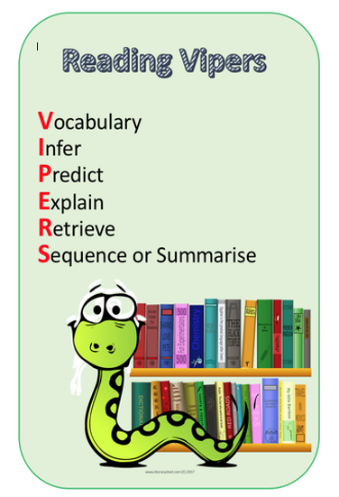
We believe the development of children’s vocabulary is a vital tool in learning in understanding the full curriculum and have provided every child with a reading journal, which is used to support their reading skills. Every teacher refers to content domains for key stage one and two and provides activities for every child to develop their understanding of these. We use VIPERS, from The Literacy Shed, to support with this. VIPERS stand for:
Vocabulary
Infer
Predict
Explain
Retrieve
Sequence (in key stage one) or Summarise (in key stage two)
We believe that every child should have access to quality, inspirational reading materials in order that they develop a keen interest in the written word, which will stay with them throughout life. This is why we have invested – and continually invest - time in updating our school library with the support of school librarians in Year 6. We strive to make reading as much fun as possible through visiting authors and initiatives such as World Book Day.
Reading Curriculum:
Reading Progression Document:
Phonics
Phonics is taught daily in Early Years and Key Stage 1 and is embedded throughout our curriculum. During our discrete sessions, children follow the Read, Write Inc scheme. This teaches them the ‘pure sounds’ in a carefully ordered way. See the link below for more information and a copy of a presentation.
Parents - Ruth Miskin Literacy
Parent Meeting Introduction to Read Write Inc.

English Curriculum Statement:
https://www.warrinermultiacademytrust.co.uk/attachments/download.asp?file=419&type=pdf