
Computing
At Grendon Underwood School, we know that Information and Communication Technology (ICT) is an integral part of our daily lives. Our computing curriculum provides our children with the knowledge and skills to use computational thinking, creativity, and to prepare them as active participants in a digital world. We aim to equip children with a rich breadth of understanding and confidence around the principles of information and computation, how digital systems work, and how to put this knowledge to use through programming.
We understand that our children have easy access to a wealth of digital media and can explore, connect and learn in ways never before imagined. Therefore, digital literacy and learning to use technology safely is at the heart of our computing, providing children with the skills, knowledge and experiences that will enable them to be responsible, competent, confident and creative digital citizens.
In each class, we use interactive touchscreen boards to deliver teaching and support active learning. Children can interact with a range of applications on these as well as using iPads, laptops and the computers in our computer suite. Through these technologies, children learn how computing provides access to limitless information from a range of sources: experts, individuals, communities and cultures from around the globe.
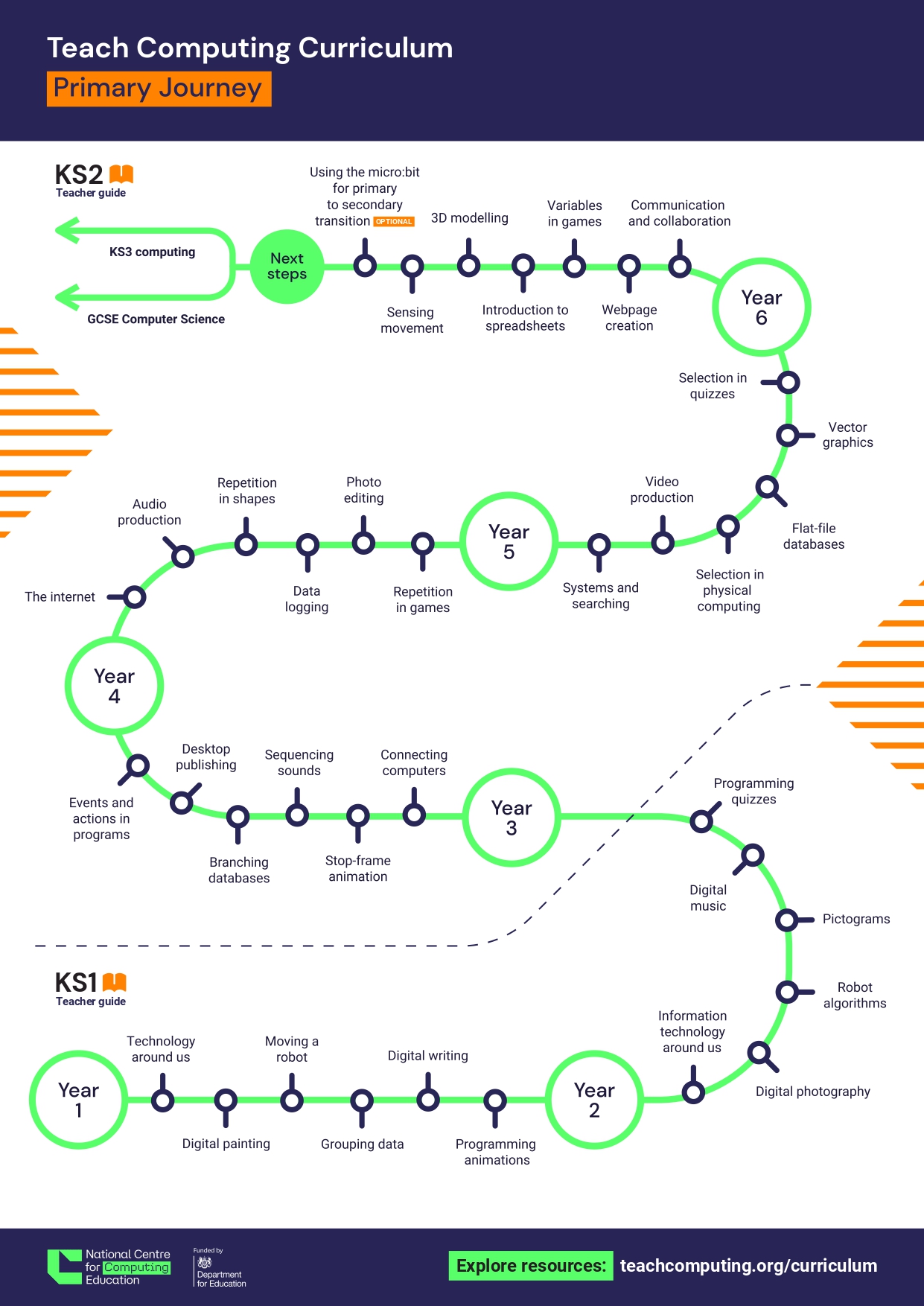
We use National Centre for Computing Education, a comprehensive website of online tools and content, which includes an exciting collection of curriculum-focused activities, creative tools, programs and games to support and inspire creative learning. The scheme provides the rich vocabulary required to support children’s computational thinking, opportunities to experience a range of tools and applications whilst ensuring that all learning builds towards achieving specific goals.
A high-quality computing education equips pupils to use computational thinking and creativity to understand and change the world. Computing has deep links with mathematics, science, and design and technology, and provides insights into both natural and artificial systems. The core of computing is computer science, in which pupils are taught the principles of information and computation, how digital systems work, and how to put this knowledge to use through programming. Building on this knowledge and understanding, pupils are equipped to use information technology to create programmes, systems and a range of content. Computing also ensures that pupils become digitally literate – able to use, and express themselves and develop their ideas through, information and communication technology – at a level suitable for the future workplace and as active participants in a digital world.
Primary Computing Curriculum:
Computing Curriculum Statement:
https://www.warrinermultiacademytrust.co.uk/attachments/download.asp?file=417&type=pdf